
Your Kids Are Absorbing 2.8× More Blue Light Than You
The light in your living room is a mild inconvenience for you. For your child, it's a biological hammer hitting a circadian system that hasn't finished building itself yet.
I want to be straight with you about something most people in this space get wrong.
When blue light gets talked about, it's framed as a screen problem for adults. "Don't scroll before bed." Fine. True. But it misses the part that actually matters.
Your child is not a small adult. Their eyes are built completely differently — and that single anatomical fact means the same lamp that barely registers in your body is suppressing nearly all of your child's melatonin before they even get to bed.
This isn't speculation. We have controlled lab data. Children and their parents put under identical lighting conditions. Parents: mildly affected. Children: melatonin almost completely wiped out. Same room. Same light. Completely different biological outcomes.
Here's what's happening, and what to do about it.
What Blue Light Is and Why It Exists in Everything Now
Visible light is a spectrum. Long wavelengths at one end: red, orange, amber. Short wavelengths at the other: violet and blue. Blue sits between 380–500nm. Short wavelengths carry more energy. That's why blue light is biologically active in a way that red light isn't.
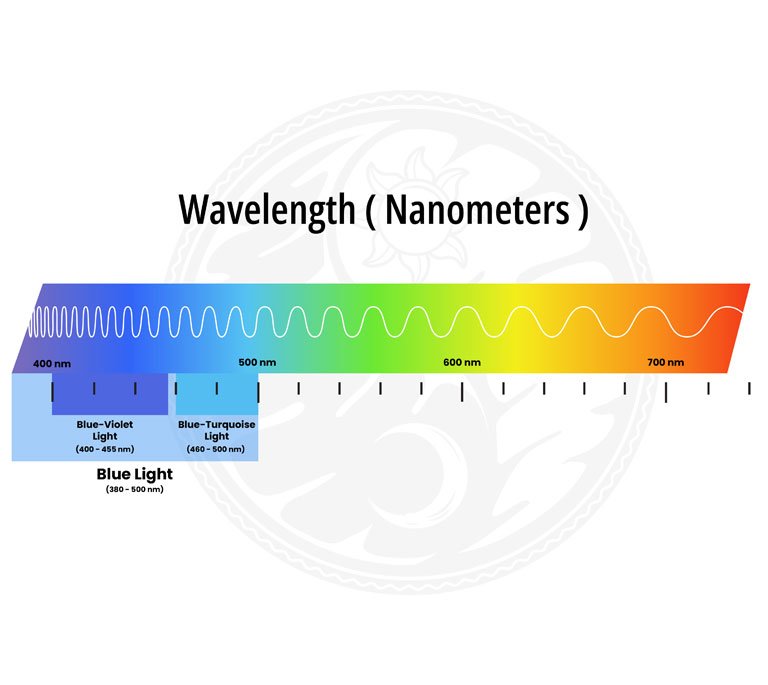
Your body uses blue light as a daylight signal. When your retina detects it, a message goes to the suprachiasmatic nucleus in your brain: it's daytime, stay awake, suppress melatonin, raise cortisol. For most of human history, this signal switched off at sunset. The sky went orange, then dark. Your body knew what to do.
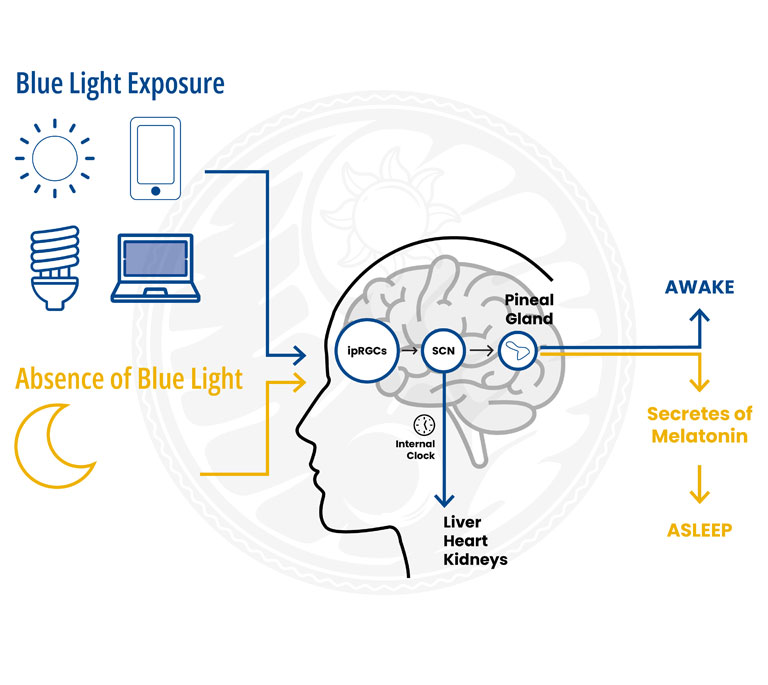
That sunset signal doesn't exist anymore
LED bulbs emit a spike of blue wavelengths as part of their white light. So do LED-backlit screens. So does the fluorescent tube in the bathroom. So does the nightlight in your child's room. The blue signal that used to disappear at dusk now runs 24 hours a day inside your home — and your child's brain can't tell the difference between that and noon sun.
LED ceiling lights · LED strip lighting · Smartphones & tablets · Televisions · Computer monitors · Nightlights (most modern ones) · Fluorescent tubes · LED toys and children's devices
Walk through your child's bedroom at dusk. Count the light sources. That's the environment their hormonal system is trying to read at 8pm.
Why Children's Eyes Are Fundamentally More Vulnerable
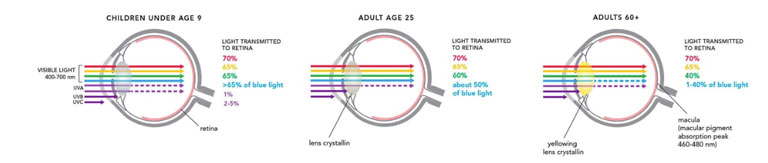
Not all light that enters the eye reaches the retina. Much of it gets filtered along the way, primarily by the lens. Here's the thing about the adult lens: it's been yellowed by decades of UV and light exposure. That yellowing is actually protective. Your lens absorbs a significant proportion of short-wavelength light before it can reach the retina. The older you are, the stronger that natural filter becomes.
A child's lens is crystal clear. Optically pure. No yellowing yet. So the blue light that gets partly absorbed by your lens passes straight through your child's lens and hits their retina almost completely unimpeded. On top of that, children have larger pupils — they physically collect more light per unit of time.
More blue light reaches a newborn's retina versus an adult, due to pupil size and lens clarity (Point, 2018)
Melatonin suppression in children at moderate indoor light (580 lux) — versus 46% in adults under identical conditions
Greater photic input a 10-year-old's circadian system receives versus a 45-year-old from identical lighting
Point (2018) in Radioprotection put numbers on this directly. Due to differences in pupil diameter and focal length, the safe blue-light exposure threshold for a newborn is approximately 2.8 times lower than the standard set for adults. The safety limits we use to call a lamp "safe" were calculated for adult eyes. Nobody ran the numbers for your infant.
Source: www.eyesafe.com
The clear lens problem
As adults age, the crystalline lens yellows and naturally filters blue wavelengths before they reach the retina. Children's lenses are optically pure — no such protection exists. Blue light that partially bounces off an adult's lens hits a child's retina almost unimpeded.
A 2008 research model estimated that a 10-year-old's circadian system receives roughly twice the photic input of a 45-year-old from identical lighting conditions. The light is the same. What their brain receives from it is not.
Melatonin Is Not Just a Sleep Hormone. Here's What Suppressing It Actually Does.
Melatonin gets sold as a sleep aid. That framing undersells it badly. Melatonin is your body's darkness signal. When it rises, a cascade begins: cellular repair, immune activity, growth hormone release. These processes are time-locked to the melatonin cycle. When melatonin is suppressed, they don't happen on schedule. Or they don't happen at all.
For children, this cascade isn't optional maintenance. Growth hormone is released primarily during deep sleep, closely tied to that melatonin rise. Sleep quality in childhood is directly linked to cognitive development, emotional regulation, immune function, and metabolic health. Disrupt melatonin, and you're not just dealing with a kid who's hard to get out of bed. You're interfering with the hormonal machinery that's actively building them.
Blue light is the most potent melatonin suppressor we know of
Of all light wavelengths, short-wave blue (around 450–480nm) suppresses melatonin most effectively. The reason is anatomical: the retinal ganglion cells responsible for sending time-of-day information to the brain's master clock are maximally sensitive to blue wavelengths. Even low levels of blue-enriched light can tell a child's brain "it's still daytime" and hold melatonin back.
Zhao et al. (2018) in the International Journal of Ophthalmology documented the mechanism clearly: blue light penetrates to the retina, stimulates the brain, inhibits melatonin secretion, and elevates cortisol. This isn't a theory about screens being bad. It's the documented biological pathway by which the ceiling light in your child's bedroom tells their body to stay awake.
In a controlled experiment, children averaging 9.2 years old were exposed to moderate indoor light — 580 lux, typical home room lighting. Result: 88.2% melatonin suppression at bedtime. Adults under identical conditions: 46.3% suppression. In a second experiment measuring their actual home environments under normal room lighting, children's melatonin was significantly suppressed. Adults in the same rooms: largely unaffected. Same light. Same room. Completely different hormonal outcomes.
That study, published in the Journal of Clinical Endocrinology & Metabolism, is one of the most important pieces of research on this topic — and most parents have never heard of it. It measured children and their parents in the same room under the same lighting. The disparity isn't marginal.
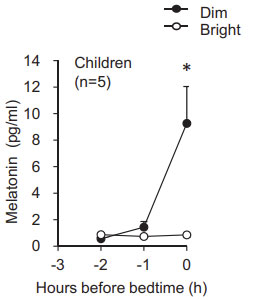
Source: Higuchi et al. (2014). doi: 10.1210/jc.2014-1629
Lee et al. (2018) followed up by testing different color temperatures on children and adults. Cool white LED at 6200K: 81.2% melatonin suppression in children, 30.4% in adults. Even warm white at 3000K suppressed children's melatonin by 58.1%. The researchers were unambiguous: warm, low-color-temperature light is the minimum standard for children's environments at night. Not a preference. A minimum.
- Adults: 30.4% melatonin suppression
- Children: 81.2% melatonin suppression
- Children reported significantly lower sleepiness
- Children's sleepiness did not increase toward bedtime
- Adults: 30.4% melatonin suppression
- Children: 58.1% melatonin suppression
- Better — but still dramatically worse than adults
- Researchers recommend this as a floor, not a ceiling
What Disrupted Sleep Is Actually Doing to Your Child
Tired kids are annoying. That's the everyday version of this problem. The research version is more serious.
Between 50 and 90% of school-aged children and adolescents don't get enough sleep, according to US population data in LeBourgeois et al. (2017) in Pediatrics. Screen media in the bedroom is consistently identified as a major contributing factor. In a systematic review of 67 studies (Hale & Guan, 2015), 90% found that screen time adversely affected sleep outcomes in children — primarily through delayed bedtimes and reduced total sleep time. Not 60%. Not 75%. 90%.
Three mechanisms, not one
Screens damage children's sleep through three distinct pathways:
Time spent on a screen is time not spent sleeping. Each hour of television is associated with approximately 5–10 minutes of delayed bedtime. For mobile devices, one UK study found that bedtime use shortened sleep by 45 minutes in pre-teens. Simple arithmetic with compounding consequences.
Screen content — games, video, social feeds — is engineered to be stimulating. An aroused brain takes longer to transition into sleep. This applies even to content that seems calm. The interactive nature of screens makes it worse than passive television.
The blue light emitted by screens suppresses melatonin, delays circadian phase, and increases alertness. This mechanism operates independently of what's on the screen. A neutral, boring screen still emits the same blue light. And it hits children dramatically harder than adults.
Staples et al. (2021) in Infant Behavior and Development used actigraphy — wrist devices that measure sleep objectively — in 30-month-old toddlers. Families with screens as part of the bedtime routine showed measurably shorter total sleep, later sleep timing, and more night-to-night variability. These weren't parent impressions collected via survey. They were objective measurements.
The downstream consequences of chronic short sleep in children are well-documented: higher obesity risk, worse academic performance, impaired emotional regulation, weakened immune function, increased risk-taking behavior. Sleep isn't optional equipment. It's when development happens.
Blue Light and the Developing Eye: The Retina, the Lens, and Myopia
The melatonin story gets most of the attention. But blue light also acts directly on the eye itself — and given how much time children now spend with screens close to their faces, this deserves more than a footnote.
What's happening in the retina
Blue light penetrates through the cornea and lens all the way to the retina — the light-sensitive tissue at the back of the eye that converts photons into neural signals. Zhao et al. (2018) describe the mechanism: blue light stimulates the production of reactive oxygen species (ROS) — unstable molecules that damage cells through oxidative stress. In the retina, this destroys photoreceptor cells and retinal pigment epithelial cells. Animal studies show measurable retinal cell disorder after 24 hours of blue LED exposure. Long-term, this pathway is associated with accelerated age-related macular degeneration.
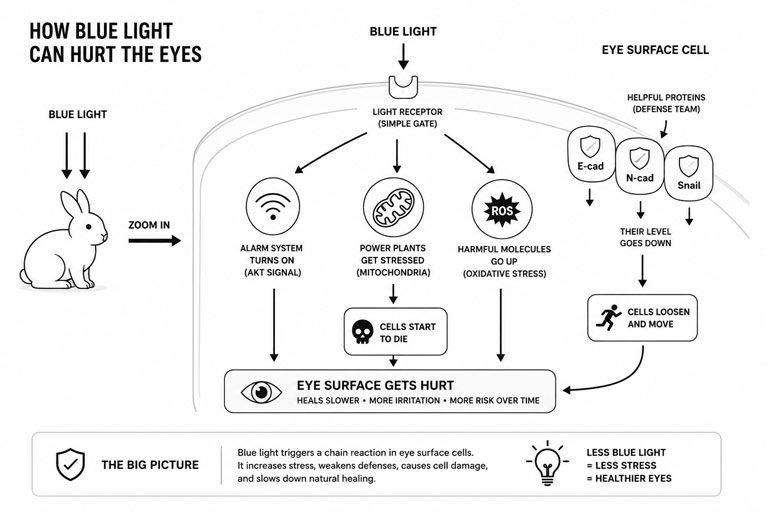
Adult lenses absorb a significant portion of blue and UV-A light before it reaches the retina. Children's clear lenses don't. Point (2018) calculated that because of this, a light source in the "no-risk" category for an adult could generate retinal overexposure in a newborn in as little as one hour — versus 2 hours 45 minutes for an adult. The safety standards for lamps were designed for adult eyes. They don't account for infant anatomy at all.
The lens and what accumulates over decades
The lens absorbs short-wave light as a defence mechanism for the retina. This protection has a cost. Blue light induces reactive oxygen species in lens epithelial cells, contributing to cataract development over time. The lens yellows and clouds through decades of light exposure. Children who accumulate high blue light exposure early in life may be accelerating that process.
Lutein and zeaxanthin — carotenoids in leafy greens and eggs — are the eye's primary dietary antioxidant defence. They're present in the lens and macula, and they absorb blue light. Diet matters here, particularly for children with high blue light exposure.
Myopia — the evidence keeps growing
Evidence linking screen use to myopia in schoolchildren is accumulating. Zhao et al. note that screen reading correlates with the incidence and development of nearsightedness, and that the correlation tracks with total screen reading time. The mechanism involves the focusing demands on the eye at close distance — and potentially the role of blue light in retinal dopamine signalling that controls eye growth.
Worth noting: daytime outdoor blue light under natural conditions appears to have a protective effect against myopia — specifically through retinal dopamine release. The risk isn't blue light per se. It's artificial blue light indoors at close range, particularly after dark. Context determines the biology.
How can you tell if your child is becoming nearsighted?
Most children won't tell you they can't see clearly. Not because they're hiding it. Because they think everyone sees the world the same way.
Watch for these signs:
Squinting to see the TV, road signs, or the classroom board.
Sitting closer to screens or holding books unusually close.
Frequent eye rubbing, especially after reading or screen time.
Headaches after homework or other close-up activities.
Sudden drop in school or sports performance caused by difficulty seeing distant objects.
If you notice one or more of these, book a comprehensive eye exam. The earlier myopia is detected, the better the chances of slowing its progression.
What to Actually Do About It — Starting Tonight
None of this requires eliminating screens or raising your kids in a cave. It requires knowing where the risk is concentrated — nighttime, close proximity, blue-rich sources — and making targeted changes there.
1. Change the bedroom lights first — and don't stop at "warm white"
This is the highest-leverage move. But here's where most advice stops short: even 2700K "warm white" LEDs — the ones sold as the safe option — still contain a meaningful blue spike in their spectrum. Look at the left chart below. That blue peak at 450nm is present in every standard LED bulb, including the warm ones. It's built into how LED phosphor technology works. You can't colour-temperature your way out of it.
Lee et al. (2018) showed that even the gap between 3000K and 6200K produced dramatically different melatonin outcomes in children. But 3000K still suppressed children's melatonin by 58.1%. "Warmer" isn't the same as blue-light-free.
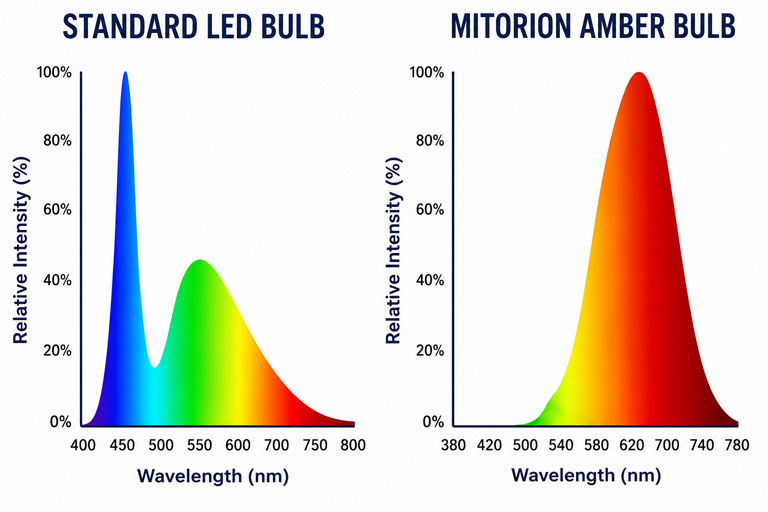
The right chart is a Mitorion amber bulb. No blue spike. No output at all below 560nm. The entire emission sits in the amber-red range where it belongs after dark. This is what blue-light-free actually means — not a filter, not a coating, not a colour temperature number. A spectrum that simply doesn't contain blue light.
All Mitorion lights are blue-light-free by design — not by filter. Standard LEDs generate white light by coating a blue LED chip with phosphor. The blue leaks through regardless of colour temperature. Our bulbs use a fundamentally different emission approach: amber and red phosphor with no underlying blue chip. What you see in that right-hand spectrum is what reaches your child's retina.
There's a second issue that doesn't get discussed alongside blue light enough: flicker. Most LED bulbs flicker at 100–120Hz — invisible to the eye but detectable by the nervous system. Research links high-frequency flicker to elevated cortisol, headaches, and visual fatigue. This matters particularly for children, whose nervous systems are still developing and whose neurological response to flicker differs from adults. All Mitorion bulbs are flicker-free. That's not a marketing detail — it's a direct input into how the nervous system behaves under artificial light.
The bedroom, and anywhere your child spends the 2–3 hours before bed, needs genuinely blue-light-free lighting. Not warmer. Not lower colour temperature. Free. If there's a blue spike in the spectrum, it's doing biological work on your child's melatonin cycle whether the room feels warm or not.
2. No screens in the bedroom — and mean it
The American Academy of Pediatrics recommendation (cited in LeBourgeois et al., 2017) is to remove all electronic media from children's bedrooms — TVs, games, computers, tablets, phones. Not because screen time is culturally bad. Because even a screen left idle in a room emits blue light that suppresses melatonin in a child's space.
Staples et al. (2021) found that children with screen use as part of the bedtime routine had measurably shorter and more variable sleep — even when that screen use was infrequent. Occasional exposure still disrupts the reliability of the sleep-onset process. Consistency matters.
3. Dim down 60–90 minutes before bed
Melatonin typically begins to rise 1–2 hours before a child's natural sleep time. Bright or blue-enriched light during this window holds that rise back. Higuchi (2014) found that ordinary home room light was sufficient to significantly suppress melatonin in children before bedtime. Dim the space, shift to amber lamps, remove screens. Bath, story, quiet activity. The routine itself signals the brain — which reinforces the melatonin signal rather than fighting it.
4. The nightlight problem — most parents miss this one
A cool-white or blue-spectrum LED nightlight running in your child's room all night is actively suppressing melatonin throughout the night. Point (2018) specifically flags luminous toys and nightlights as devices warranting particular scrutiny given infant eye anatomy and proximity to the face in the cradle or bed.
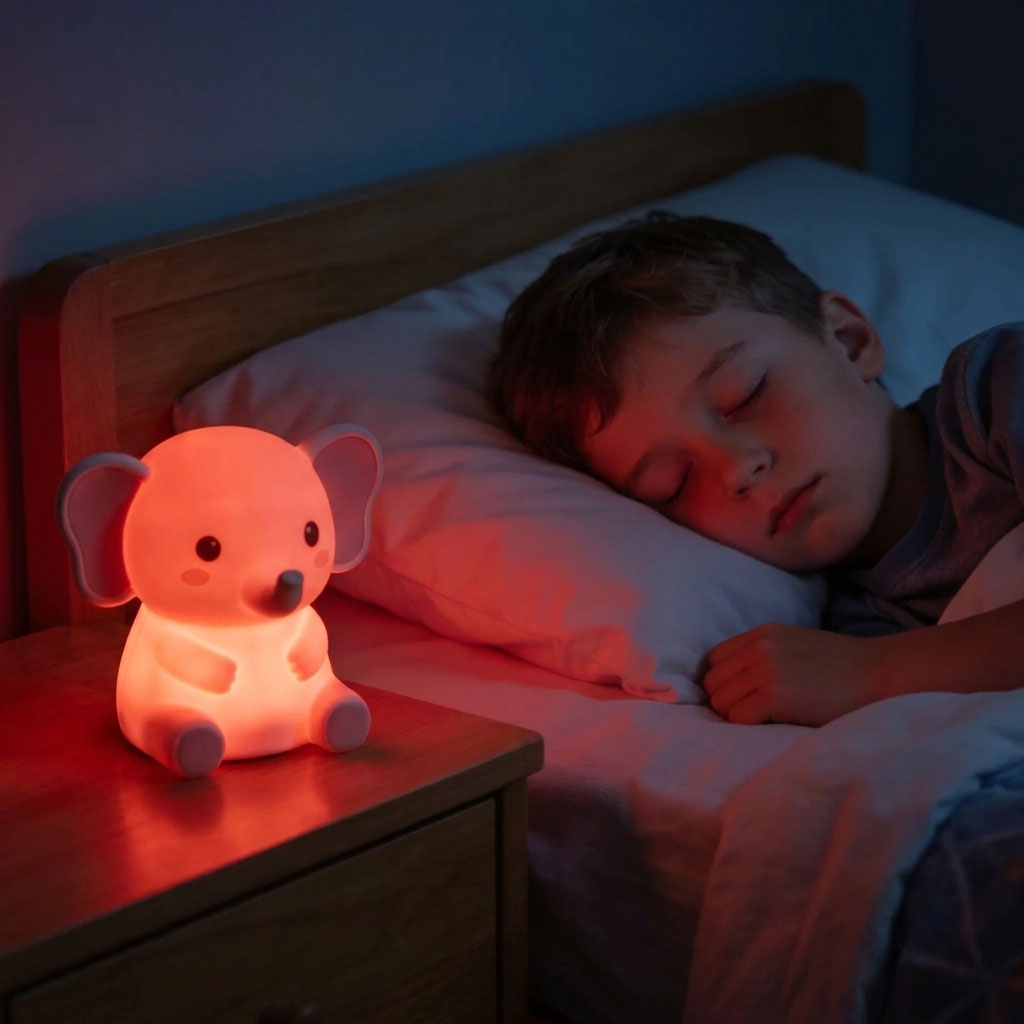
If your child needs a nightlight, use one in the deep amber or red spectrum — around 600–700nm. These wavelengths have minimal impact on the circadian system and melatonin production. The colour temperature matters. Most modern nightlights are the wrong colour.
5. Get them outside during the day
Robust daytime exposure to bright natural light calibrates the circadian system and reduces sensitivity to evening light. This isn't about more screen time outdoors. It's actual time outside — without sunglasses during bright hours — so the system gets its natural daytime input. Children who spend most of their day under dim artificial indoor light may be more sensitive to even moderate evening lighting at home. The daytime signal matters as much as the evening signal.
The short version, for people who are busy
- Your child absorbs up to 2.8× more blue light than you from the same light source
- Ordinary home room lighting suppresses nearly all of a child's melatonin before bed — while barely affecting adults in the same room
- 90% of studies on screen time and children found adverse sleep effects
- The 3 hours before bedtime are the highest-risk window
- Switching bedroom lighting to deep amber or warm-spectrum bulbs is the single highest-leverage change you can make tonight
- Screens in the bedroom — any screens — should be removed. Even occasional use measurably disrupts sleep patterns
- Red or deep amber nightlights are fine. Cool-white or blue-white nightlights are not
- Daytime outdoor light exposure calibrates the system and buffers evening sensitivity
The light in your home isn't neutral. For you, it's mostly background. For your child, it's a biological signal that reaches their retina almost completely unfiltered — and that signal tells their brain, night after night, to stay awake longer, suppress the hormones they need, and skip the developmental work that only happens in deep, timely sleep.
You don't need to be perfect. You need to know where the problem is. The bedroom is the place. The evening hours are the time. Start there. Start tonight.
- Hale L, Guan S. Screen time and sleep among school-aged children and adolescents: a systematic literature review. Sleep Medicine Reviews. 2015;21:50–58.
- Higuchi S, Nagafuchi Y, Lee SI, Harada T. Influence of light at night on melatonin suppression in children. J Clin Endocrinol Metab. 2014;99(9):3298–3303.
- Lee SI, Matsumori K, Nishimura K, et al. Melatonin suppression and sleepiness in children exposed to blue-enriched white LED lighting at night. Physiological Reports. 2018;6(24):e13942.
- LeBourgeois MK, Hale L, Chang AM, et al. Digital media and sleep in childhood and adolescence. Pediatrics. 2017;140(Supplement 2):S92–S96.
- Point S. Blue light hazard: are exposure limit values protective enough for newborn infants? Radioprotection. 2018;53(3):219–224.
- Zhao ZC, Zhou Y, Tan G, Li J. Research progress about the effect and prevention of blue light on eyes. Int J Ophthalmol. 2018;11(12):1999–2003.
- Staples AD, Hoyniak C, McQuillan ME, et al. Screen use before bedtime: Consequences for nighttime sleep in young children. Infant Behavior and Development. 2021;62:101522.
